

Dismantling the alpha dog myth
By Elle Williams, PCT-A, CPDT-KA, FFCPT
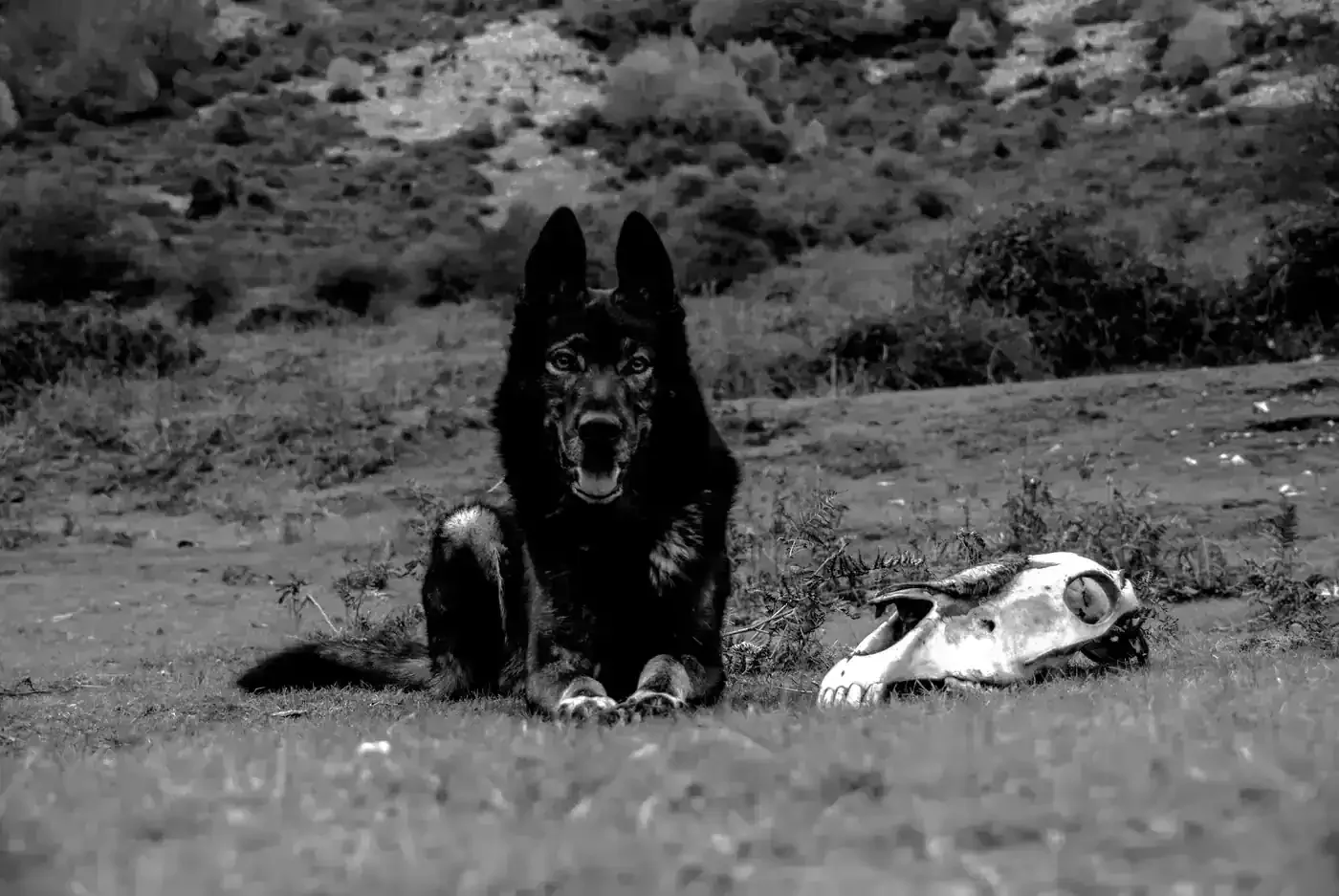
Dog resembling a Wolf laying by a Skull
I would like to apologize on behalf of both the entertainment industry and the dog training industry. I am sorry that the terms alpha, dominance, and pack hierarchy have become the default explanation for many dog behaviors, and even a way to define a dog’s disposition.
Let’s start at the beginning of how the misconception of “alpha” formed. In 1948 Rudolf Schenkel studied captive wolves, with no blood relation to one another, in a man‑made enclosure. L. David Mech, a wildlife biologist, wrote and published a best‑selling book, The Wolf: Ecology and Behavior of an Endangered Species, citing Schenkel’s study. The book described wolves fighting to maintain a social hierarchy formed by brute force and constant conflict.
The study had one major flaw. The wolves were not being studied in their natural environment under natural circumstances.
What was actually happening was that the wolves were forced by confinement to fight for resources—nothing more than that. Because the wolves were not a family unit, fights broke out often, and in order to survive, exaggerated behaviors were observed, ranging from bloodbaths to extreme acts of submission as a last resort to stay alive.
The book was published, and entertainment companies such as Animal Planet and National Geographic used these early interpretations to narrate shows that convinced viewers and readers from the 1970s through the 1990s that the fight for dominance was not only a core part of wolf society, but also applied to the dogs we share our homes with today.
Since dogs share roughly 99% of their genetic makeup with gray wolves, the terms alpha and dominant became, and unfortunately still are, commonly used to describe and diagnose the cause of behavior in our household dogs. These labels are not just used in cases of severe aggression; many ill‑informed dog trainers, including celebrity trainers like Cesar Millan, use these terms when a dog simply walks in front of a person or harmlessly passes through a doorway first.
Mech continued to study wolves. After years of observing free‑living wolves, Mech concluded that the classic “alpha wolf” concept did not accurately describe wild packs. In a 1999 paper titled “Alpha Status, Dominance, and Division of Labor in Wolf Packs,” he explicitly argued that in the wild, most packs are simply families, and that calling the parents “alphas” is misleading, effectively correcting his earlier popularization of the term.
In natural wolf families, once offspring are grown, female offspring typically remain in the pack and peacefully collaborate to achieve common goals such as hunting and tending to pups, while male offspring leave to start new family units of their own. And this is how packs are formed. Fights rarely occur within these family units. Serious aggression, where a wolf is maimed or killed, is seen only between rival groups of wolves, often over access to territory and resources.
Comparing wolves and dogs introduces a different set of problems. Dogs have evolved separately from wolves for an estimated 14,000 years. One defining characteristic of dogs is their ability to live harmoniously among unrelated dogs and often alongside other species, such as cats, livestock, and, of course, humans.
A true leader in any social group does what is in the group’s best interest. Threatening or carrying out aggressive acts comes with serious risks, including breaking the trust of group members. When a dog behaves aggressively, it is usually due to self‑preservation, territorial concerns, being cornered with no viable options, or because others in the environment are actively aggressing toward them. Fear, pain, and discomfort also significantly increase the likelihood that a dog will resort to aggression.
The terms dominant and submissive do have a place when describing behavior, but it is crucial to understand that they refer to moment‑to‑moment behavior, not a permanent personality trait. Dogs use these behaviors to communicate and avoid conflict. A good example is when dogs chase one another in play. One dog may use “dominant” behavior to suggest they want to chase; if the other dog accepts, it may display “submissive” behavior, and the game begins. In healthy play, dogs switch these roles frequently and fluidly.
Unfortunately, terms like alpha and dominant resonate with the human ego. Because of this, these concepts have misled how many people view and interact with their canine companions.
The hope is that this article gives readers a better understanding that our knowledge is always evolving and that we often end up disproving our own earlier conclusions. Growth occurs when we remain open to changing our beliefs in light of new evidence.
