

Barking, prey drive, digging… These are just a few of the dog behaviors trainers get called about—with the expectation that they’ll be fully eliminated.
Here’s a reality check you might find fascinating:
The behaviors owners most often want gone are the same behaviors humans wanted for the overwhelming majority of dogs’ evolutionary history. Barking was once a job. Ankle-biting was once a job. Digging, herding, hunting, protecting, alerting—all jobs.
Heck, scavenging was the OG job, with an estimated 15,000 years of employment. And yet Fluffy gets the spray bottle for doing something so genetically hardwired, it’s literally one of the fundamental reasons we have dogs in the first place.
Still need that reality check? Look at the timeline of “doggy jobs.” (Note: employment dates are estimated, rounded to about 1,000 years—exact dates just aren’t possible this far back… at this time.)
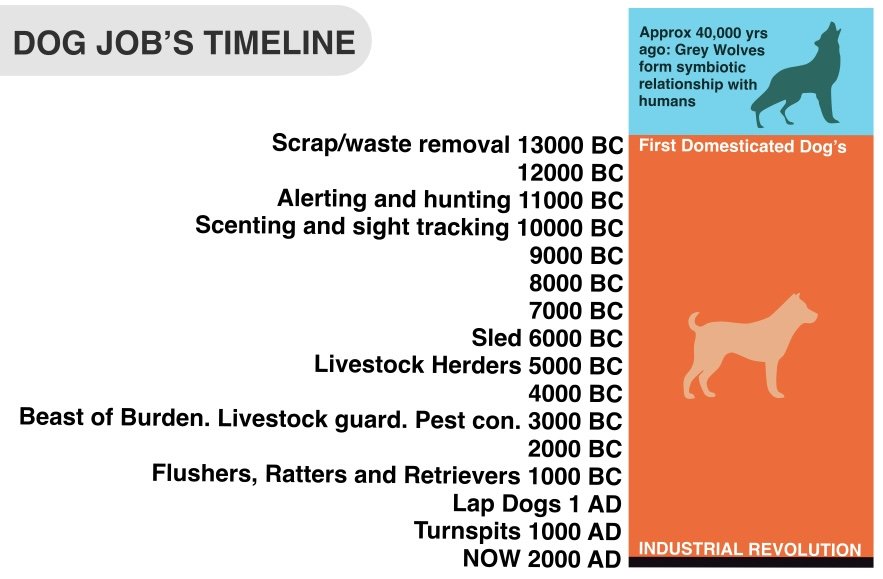
Timeline of the Job’s dogs have had in comparison to their evolutionary history.
The first job? Clean-up crew, AKA scavenging. Humans benefited by having less food waste rotting around, reducing exposure to bacteria and pests. Dogs got free meals. It’s also a big reason wolves hung around long enough to become dogs.
Humans then found new reasons to befriend dogs when they evolved the ability to vocalize with barks. Fun fact: Wolves rarely bark; dogs evolved to bark far more and in more contexts. So dogs evolved this vocalization as a domestication-related change, and humans reinforced it from day one. They alert us to potential danger; we feed them.
And that deeply ingrained predatory sequence quickly became humanity’s greatest tool. We selectively bred for dogs who would carry out tracking, stalking, chasing, catching, killing—and everything in between. Those skills became the basis for herding, flushing out foxes, killing rats. We even added less innate behaviors like hauling and sledding… because we had things to move and places to be.
So you see that orange box? That’s how long dogs have been doing those jobs.
Ironic, isn’t it? Newer “jobs” like retrieving don’t carry the weight of “behavior problem,” yet the old jobs are almost always considered problems. Cough cough—alert barking.
They started being seen as problems as societies industrialized and urbanized over the last few centuries. Many dogs lost their jobs when humans created tools, guns, wheels, engines, and more.
And that brings us to the black line on the timeline. If you can see it. Here we are now, in modern society. Not everyone lives in suburbia, but the overwhelming majority of “problem dogs” apparently do. Although dogs are incredibly adaptable, approx 15,000 years of selective breeding should absolutely carry weight when we set our expectations.
In just a few hundred years, dogs went from having jobs, large open areas, and fewer restrictions to crammed housing, traffic, leashes, technology, and humans gone for eight-hour workdays.
Knowing what your dog’s breed was bred to do—while always considering the individual dog in front of you—is absolutely vital to setting up their life and setting our expectations.
Harmony can be reached. So instead of placing the weight of quick evolutionary change on your dog, place the responsibility for change on yourself. They didn’t choose the home they live in… we chose to put them in it.
